

Vancouver, BC, Canada (WNews Analysis) — Gasoline prices in British Columbia could reach $2.00 per litre in the next few days, and possibly $2.30 to $2.50 per litre within weeks if the current oil shock gets worse, according to WNews analysis of how crude oil prices affect retail gasoline.
This analysis follows a sharp rise in crude oil prices due to growing tensions in the Middle East. The conflict, which now involves Iran, threatens shipping through the Strait of Hormuz, a key route for global energy supplies.
About 20% of the world’s oil supply moves through the Strait of Hormuz. Any disruption there can quickly affect global energy markets and fuel prices.
Oil Markets Moving Rapidly
Global oil prices have jumped quickly as the conflict has grown. Benchmark crude rose from about $47 per barrel earlier this year to around $90 per barrel in just a week.
Energy analysts warn that if shipping in the Persian Gulf is disrupted, crude oil prices could jump to $100 to $150 per barrel. Prices have not reached this range since the previous major geopolitical shocks.
How This Situation Differs From the 2022 Energy Shock
This oil shock is different from the 2022 gasoline price surge in a few key ways. In 2022, when prices in B.C. briefly went above $2.50 per litre, the provincial carbon tax added about 10 to 12 cents per litre. That tax is no longer included in retail fuel prices, so the starting price for drivers is now a bit lower than during the last crisis. Because of this, a similar spike in crude oil prices today would likely lead to slightly lower pump prices than in 2022, if everything else stays the same.
Still, analysts point out that the main factors behind gasoline prices have not changed much. Crude oil costs remain the largest share of what drivers pay, followed by refining, transportation, and other taxes. If global oil prices jump to $120 to $150 per barrel, not having a carbon tax would only soften the increase slightly. In that case, prices could still reach levels seen in 2022, especially if refinery profits rise or supply problems arise due to ongoing tensions.
How Oil Prices Translate Into Gasoline Prices
Several factors affect gasoline prices, including crude oil costs, refining profits, transportation costs, taxes, and retail distribution.
According to Natural Resources Canada, crude oil accounts for the largest portion of gasoline prices in Canada, followed by refining costs and government taxes.
Energy economists often use this rule of thumb:
Every $10 increase in crude oil prices raises gasoline prices by roughly 6–8 cents per litre.
WNews Price Impact Model
WNews used the following steps to estimate possible gasoline prices in British Columbia.
Step 1: Starting Price
Average B.C. gasoline price in early March:
$1.80 per litre
This reflects prices before the recent surge in crude oil.
Step 2: Estimate Oil Price Pass-Through
If crude oil increases:
| Oil Price | Increase from $90 | Estimated Pump Impact |
| $100 | +$10 | +6–8¢/L |
| $120 | +$30 | +18–24¢/L |
| $150 | +$60 | +36–48¢/L |
Step 3: Apply Pass-Through to Retail Price
Starting from $1.80/L, the potential price ranges become:
| Oil Scenario | Estimated B.C. Gas Price |
| Oil $100 | $1.88 – $1.95 |
| Oil $120 | $2.00 – $2.10 |
| Oil $150 | $2.15 – $2.30 |
However, these estimates assume only crude oil pass-through.
In past energy shocks, gasoline prices also rose due to:
- refinery margin spikes
- transportation costs
- panic buying
- currency fluctuations
When these additional factors are included, prices can rise by another 20 to 30 cents per litre.
This means the worst-case scenario could see prices in B.C. reach $2.30 to $2.50 per litre, similar to the record highs during the 2022 global energy crisis.
Methodology & Disclaimer
Methodology:
The gasoline price scenarios referenced in this article are based on publicly available fuel market data and commonly used crude-to-retail pricing relationships referenced by organizations such as Natural Resources Canada and industry analysts. Crude oil typically represents roughly 45–55% of the retail gasoline price in Canada. Analysts often estimate that each $10 increase in crude oil prices can translate into approximately 6–8 cents per litre at the pump, although the exact impact varies by region.
For the purposes of this analysis, WNews used a baseline gasoline price of approximately $1.80 per litre, reflecting observed retail prices in parts of British Columbia before the recent surge in crude oil markets. Potential price ranges were then calculated by applying the crude-price pass-through estimates to various oil price scenarios.
These estimates are intended to illustrate how movements in the global energy market could influence retail fuel prices.
Disclaimer:
The price figures presented are illustrative projections only and should not be interpreted as forecasts. WNews does not predict or forecast fuel prices or financial markets. Actual gasoline prices may vary significantly depending on refinery capacity, regional supply constraints, transportation costs, taxes, exchange rates, and geopolitical developments.
Why British Columbia Is More Sensitive
British Columbia is especially sensitive to global oil price shocks because of the structure of its fuel supply and taxes. The province relies heavily on fuel shipped from refineries in Washington State and Alberta. Metro Vancouver also has additional regional taxes to fund transportation projects. Since there is limited refining capacity on the West Coast, any supply problems or crude oil price increases tend to show up quickly as higher pump prices.
British Columbia’s gasoline market is relatively isolated from the large refining hubs that supply much of Eastern Canada and the U.S. Midwest, reducing the ability to quickly offset supply shortages. As a result, price movements in global oil markets often appear at the pump in British Columbia faster and more sharply than in most other Canadian provinces.
Gasoline prices in B.C. tend to respond more strongly to global oil shocks than other Canadian provinces due to structural factors, including:
- higher fuel taxes
- limited refining capacity on the West Coast
- reliance on imported fuel during shortages
- stricter environmental fuel standards
- heavy demand in Metro Vancouver
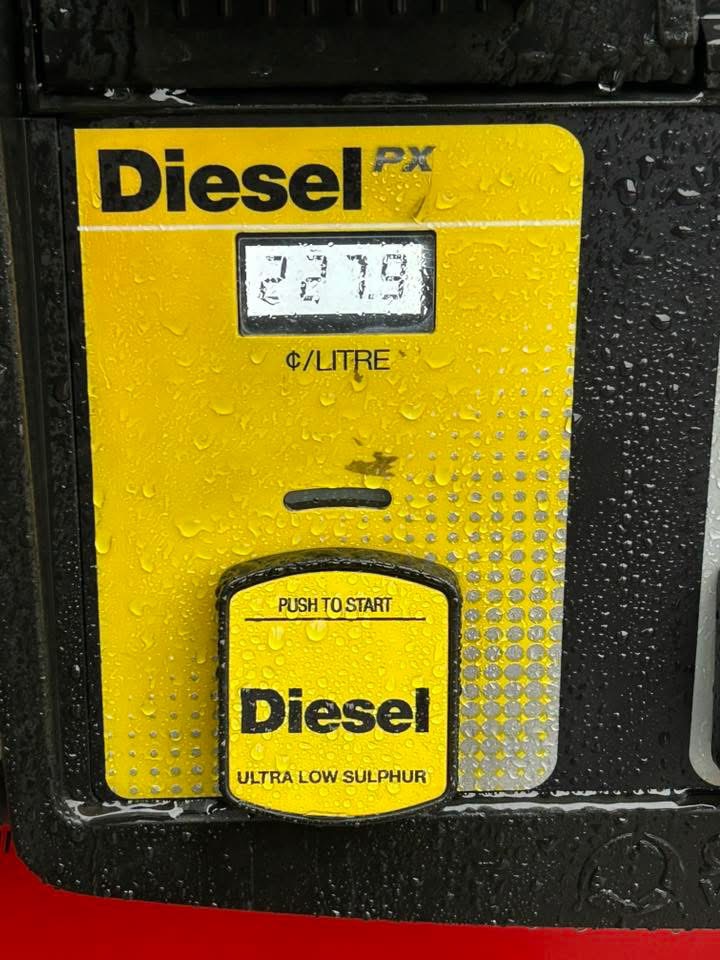
These factors mean B.C. starts with higher prices, so global oil shocks have a bigger effect at the pump. A photograph shared by a reader in a Maple Ridge community Facebook group shows diesel selling for 227.9 cents per litre, a level typically associated with significant stress in global energy markets.
Diesel prices often rise before gasoline during energy shocks because freight, industry, and heating all depend on diesel or similar fuels. When crude oil prices rise quickly, refiners and wholesalers often prioritize meeting diesel demand, which pushes those prices higher. Analysts say that big jumps in diesel prices can be an early sign that wholesale fuel markets are tightening, and that gasoline prices at the pump may soon rise too.
Government Response Possible
When gasoline prices last approached $2.50 per litre in 2022, the Government of British Columbia temporarily removed the provincial fuel tax for three months to provide relief to motorists.
If prices return to those levels, governments may be pressured to take similar steps.
Bottom Line
If crude oil prices stay around $90 to $100, gasoline prices in B.C. may range from $1.90 to $2.05 per litre.
But if oil rises to $120 to $150, gasoline prices could reach $2.30 to $2.50 per litre within weeks, especially if refinery profits and risk premiums increase.
For now, energy markets remain very volatile as investors watch developments in the Middle East and global shipping.